Here's the guide you asked for on Instagram 👋
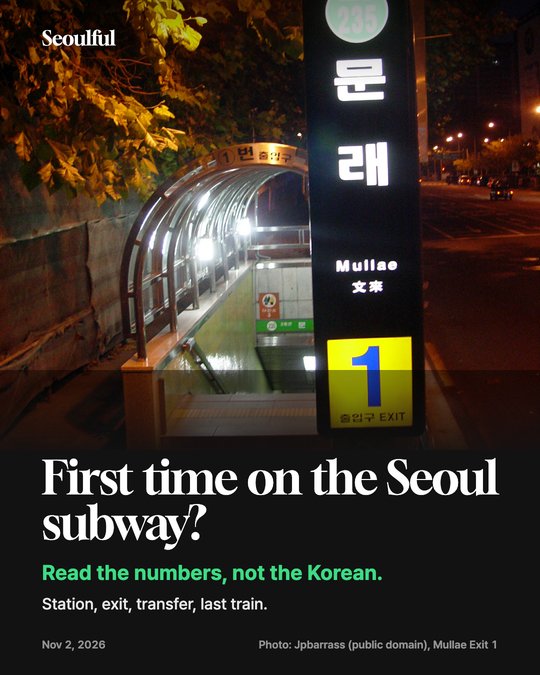
Seoul subway guide for first-timers
- Station numbers
- Line + stop order: 228 = Line 2, stop 28
- Exits
- Numbered; Naver Map shows which one to use
- Bus transfer
- Board within 30 min of tapping out (60 min, 9 PM–7 AM)
- Last trains
- About 1 AM weekdays; about an hour earlier on weekends and holidays
- Fare
- From ₩1,550 with T-money · Climate Card pass from ₩5,000 (1 day)
You don't need to read Korean to ride the Seoul subway. You need the numbers: the station number, the exit number, the transfer window and the last train. Here's how each one works, plus what a ride costs.
Line 2 train, Seoul · Photo: R151trains (CC0), via Wikimedia Commons
How station numbers work
- 228Line number + stop order
Seoul Nat'l Univ. Station is 228: Line 2, the 28th station. The stations on either side are 227 (Nakseongdae) and 229 (Bongcheon).
- COUNTSubtract to count your stops
From 228 to Hongik Univ. (239) is 11 stops. Seoul says you can also tell the direction: on Line 2 at Seoul Nat'l Univ., higher numbers run toward Hongik Univ. and City Hall.
- SIGNSThe number is on the platform sign
In 2023 Seoul added station numbers to the station-name signs on the platform screen doors at all 275 stations on Lines 1–8, so you can check where you are without reading Korean.
Find your exit before you leave the platform
- EXITSMost stations have several numbered exits
Each exit comes up on a different street or corner, so the exit number matters as much as the station.
- CHECKLet Naver Map pick the exit
Search your destination in Naver Map (set it to English: MY → gear icon → Language). The route shows the exit closest to where you're going. Our Naver Map guide: seoulful.guide/navermap
- TIPMeet at an exit number
Meeting friends? Say "Hongik Univ. Exit 9" instead of the station name; big stations are huge underground (our tip).
Transfers
- LINESFollow the line color and number
Each line has its own color and number on the signs. Naver Map's subway route also shows which way to board and the car number for a quick transfer.
- BUSSubway to bus: 30 minutes
With a transport card, you get the transfer discount if you board the next bus or train within 30 minutes of getting off (60 minutes from 9 PM to 7 AM), for up to 5 boardings in a row. Tap your card when you get off the bus too.
- EARLY20% off before 6:30 AM
Your first ride of the day is 20% off the base fare if you board before 6:30 AM with a transport card.
Last trains
- WEEKDAYUntil about 1 AM
Since 2022, Seoul's subway runs until about 1 AM on weekdays. Example from the Seoul Metro timetable (checked Oct 28, 2026): Hongik Univ. on Line 2, last trains around 12:49–12:50 AM.
- WEEKENDAbout an hour earlier
Saturdays, Sundays and holidays run a separate timetable. Same example: Hongik Univ. on a Saturday, about 11:49–11:51 PM.
- CHECKCheck your own station
Last trains differ by station and direction, and the late ones often stop partway down the line. Check the time and the train's final stop in Naver Map before a late night out.
- AFTERMissed it?
Night buses (N buses) run after the subway stops, about ₩2,500 by card. Our late-night guide: seoulful.guide/lasttrain
Paying: T-money or Climate Card
- T-MONEYPay per ride, from ₩1,550
The base subway fare with a transport card has been ₩1,550 since June 28, 2025 (longer trips cost more). Buy a T-money card at convenience stores or station machines and top it up with cash.
- PASSClimate Card short-term pass
Unlimited Seoul subway and Seoul city bus rides: ₩5,000 (1 day), ₩8,000 (2), ₩10,000 (3), ₩15,000 (5), ₩20,000 (7), plus ₩3,000 for the card. It doesn't cover the Shinbundang Line or boarding at Incheon Airport. Full comparison: seoulful.guide/guides/seoul-climate-card-vs-t-money/
Affiliate link: if you book, Seoulful earns a small commission at no extra cost to you.
Say it in Korean (show this screen)
- Where is exit 3?
Sam-beon chul-gu eo-di-ye-yo?
3번 출구 어디예요? - Where do I transfer to Line 2?
I-ho-seon gal-a-ta-neun de eo-di-ye-yo?
2호선 갈아타는 데 어디예요? - Is this the last train?
I-ge mak-cha-ye-yo?
이게 막차예요?
Local tips
- Tap your card at the gate when you leave the station, even if you're transferring to a bus; transfer discounts are counted from that tap.
- Keep mobile data on: Naver Map's live arrivals and exit info need a connection (our tip).
- Fares and last-train times can change; check on the day.
FAQ
How do Seoul subway station numbers work?
The first digit is the line and the rest is the stop order: 228 is Line 2, stop 28 (Seoul Nat'l Univ.). Subtract two numbers to count your stops.
What time is the last subway in Seoul?
On weekdays the subway runs until about 1 AM; on weekends and holidays the last trains leave about an hour earlier. Times differ by station, so check Naver Map.
How much is the Seoul subway in 2026?
A ride starts at ₩1,550 with a T-money card. A Climate Card short-term pass costs ₩5,000 for 1 day up to ₩20,000 for 7 days.
How long do I have to transfer from the subway to a bus?
30 minutes after you tap out, or 60 minutes between 9 PM and 7 AM, to get the transfer discount.
Sources: Seoul Media Hub: what Seoul's subway and bus numbers mean (Feb 25, 2021) · Segye Ilbo: station numbers added to platform signs at 275 stations (Sep 17, 2023) · Seoul Metropolitan Government: fares, transfer and early-morning discount rules · Seoul Shinmun: subway runs until 1 AM on weekdays again (Jun 7, 2022) · Seoul Metro: station first/last train timetables (checked Oct 28, 2026) · Etoday: Seoul-area subway base fare ₩1,550 from June 28, 2025 · Seoul Metropolitan Government: Climate Card guide · NAVER press release: NAVER Map for foreign visitors (Dec 30, 2024)